Friday, August 2, 2013

Interviewing While Obviously Pregnant

I got called last week for an interview on Monday for an accounting job I applied for at the beginning of April. 

Then I got a call for two interviews later that Friday at other locations, and adding a second round interview from the one on Monday.   

It mushroomed clouded to more calls for interviews and follow-up interviews.  

I decided to take this opportunity to interview because the jobs were appealing and it would be a good experience for me to see what is it like interviewing while pregnant.  I'm more than halfway, and starting to show!  

If you're pregnant and looking for a job...

Do your part to make sure that the hiring decision was based on your ability to do the job, not because you'll give birth and need time off. 

DO NOT bring up the pregnancy during the interview process unless asked about it.  Bring up your pregnancy if you get an offer, and deal with that from there.  

In general, interviewers rather not know that you're pregnant because they need to make the most objective decision possible based on your ability and other candidates' ability to do the job, not because you're pregnant or about to get pregnant.  

Good hiring managers are interested in your skills and abilities, not your personal life.  Plus they don't want to run a risk of a lawsuit.  

Having these thoughts ingrained in my mind helped a lot with being able to focus on preparing for questions in the interview that do matter.  

If possible, hide your bump but don't freak out if you can't hide it any longer. What's wrong with you being pregnant, healthy and looking for a job anyway?  Nothing!

Things I discovered:


  • I realized that interviewers can ask a lot harder questions than the question of "are you pregnant?" 
  • I realized that I couldn't control what they'd ask me but I could control my response and reaction to a difficult, off-topic and/or illegal question.
  • I realized I couldn't control a hiring manager's decision or reaction if she/he noticed my bump.  
  • I realized that just because there are biases with interviewing pregnant women, doesn't mean you shouldn't apply for jobs you are qualified for.  
  • I realized that there's no reason to get upset or sad if I wasn't hired, pregnant or not pregnant.


QUESTIONS INTERVIEWERS MAY ASK HINTING AT YOUR PREGNANCY
You still need to answer the question.  

If you don't answer the question, or fumble your answers, this will grossly affect your chances of being hired, or in this case below, lose the crown.  Especially if the question is easy to answer.  
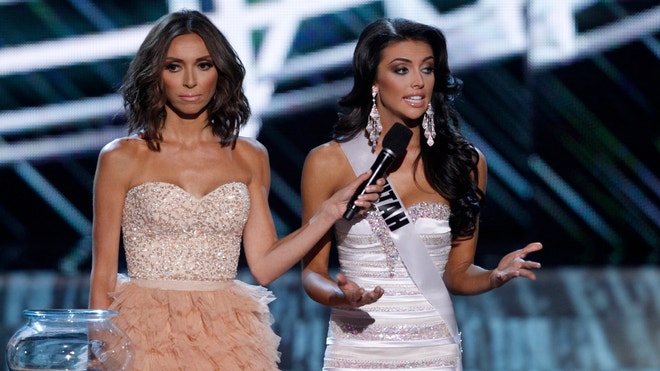

You don't want your interviewer having the same expression as Giuliana's
And WHY did it have to be Miss Utah out of all the contestants at Miss USA...


BTW the pageant question was...
"A recent report shows that in 40 percent of American families with children, women are the primary earners, yet they continue to earn less than men. What does it say about society?"

Miss Utah USA should have answered something like this:
"I think it's amazing that more women today, especially mothers have opportunities for full-time employment outside of the home, but the fact that women are still being paid less than men for the same level of work experience means that society hasn't made much progress for working women"

Booyah!  I self-crowned myself with that answer.

Be positive with your answers even though it may not be an answer they're expecting or like to hear.  That's their issue, not yours.  

Based on my research and talking with experienced managers and co-workers, here are common legal pregnancy questions and best answers to respond to them.  

How long do you plan on being employed with us?  

I would like to pursue my career here as long as I have the opportunity to
The "I plan to work until I have my baby" answer doesn't make sense to a hiring manager.  

Are you expecting to take a leave of absence in the near future?

Ask them "What is your maternity leave policy?  I will follow that policy"
That way you let them know (1) yes you will take a leave of absence, (2) they know what it's for, and (3) you won't bend rules just because you're pregnant, and will follow whatever they have in place for leaves of absence.  


If you do get a question that really is illegal...Are you pregnant?


Please don't walk out of the interview or say "That's an illegal question!"  College textbooks say to do this but don't. 

Turn it around into a positive response, and quickly get back on track focusing on your qualifications for the job.  

You are not going to die by telling the truth that you are pregnant or vice versa.  

But do report it to HR.  Some interviewers are clueless with what questions can be asked so HR can step in and assist hiring managers into the right direction.  

If you didn't get hired, and illegal questions were asked...
Consult a lawyer, win the lawsuit or...just consider yourself lucky not working for a company that focuses more on age, marital status, race, and physical characteristics rather than your actual qualifications as a viable candidate who possesses the required skills necessary to perform the essential functions of the job! 


MY EXPERIENCES INTERVIEWING WHILE PREGNANT
Before my interviews I ate a very light meal so that my tummy wouldn't stick out too much and sucked up my tummy as best as I could to practice walking in and out of interviews but according to some of my friends and family, I still look pregnant so...I gave up on doing that.  ^_^

What I ended up doing was covering up my bump with my big purse on one hand and my leather notepad on the other hand as I walked in to interview and did that again as I got up to leave.  I don't know if I look obviously pregnant when sitting down at a table.  Oh well.  Who cares?

Can...

you...


see...

me...

...now?


Whether they noticed my bump or not was not my biggest concern!  My bump may be a concern for a hiring manager, but that is something I cannot control!  

My biggest concerns at interviews were:
  • Doing well with answering the questions asked and
  • Determining if this is where I'd want to work, especially since I'm having a baby, so the work/family life balance is of greater consideration.


So far I had 5 in-person interviews while pregnant at 24-25 weeks.

Only today I had a question about pregnancy and just answered the question.  It was concerning leave of absence and they wanted to know what the leave of absence would be for.  Personally I wouldn't have asked details about leaves of absence during the interview process but oh well, it is what it is.


If you are confident about doing the job, that will show more than your obvious baby bump to a good hiring manager.  A poor hiring manager will not see that, and that is the last type of person you want to work for whether you are male or female, pregnant or not pregnant! 


I wasn't selected at the end for a job I initially interviewed last Monday but that's okay!  More interviews to come and waiting for responses from other places I interviewed.

Interviewing while pregnant has been a great learning experience for me.  It taught me to keep positive, not take things personal if I wasn't selected for a job, stay very focused on presenting myself as the best job candidate, and most importantly, be able to see what type of place I want to work at when our baby comes.

It would have been easier to get discouraged, or avoid interviewing altogether during pregnancy because it's never fun being discriminated against for a job.  I don't know when I'll get a job, but I'd still interview regardless if I was pregnant or not.

On a final note...check to see if you fit in your work slacks before interviewing so you have time to rush to the mall to buy a pair that fits. Out of the four pairs of slacks I own, only one still fits.  Hah.


If you get called for an interview and you're pregnant--don't fret, just prove that you're the best person for the job.


Thursday, August 1, 2013

Just Say No To Baby Registry


We were fine without a registry for our wedding.  So with a baby shower on the way, we aren't registering for baby girl.

My reasons not to have a registry:


  • Registering eliminates the surprise factor for the recipient.  
  • Registering eliminates the creativity and imagination factor for the giver.   
  • Registering gives away how much people spent on your gift.
  • Registering limits the giver's shopping options as well as ours.  I love many stores...I couldn't get myself to pick "the one" store to get all our things that are essential for life with a baby, as told by sales associates everywhere.  
  • People who REALLY want to get you a gift, do want to get you something you like, or something sweet, cute, or useful for the baby!
  • Anything we get as a shower gift is good; since it's our first baby.   
  • My theory I made up before our wedding worked!!!  That being, we were less likely to receive duplicates by not registering.  If we registered for a crockpot, chances are somebody is going to look for one similar to the one on our registry and get one that's cheaper.  That's how people get stuck with a ton of duplicates.  We got zero crockpots while other couples we knew that registered received 11 crockpots...

Plus....I couldn't register for baby stuff I consider too personal, no way I'm going to request gifts that involves my nursing preferences or breasts in general  ----> (O)(O)  =D


How did women and babies survive before baby registries were invented?  I'm pretty sure the majority of women of the world and their babies have been doing fine without them.


Friday, July 26, 2013

Successful Interviewing Tips - Part One

You need a job?  Three ways to get one

1. Have an insider connection

2. Work for your daddy

3. Have a successful interview.  Let's elaborate on this!


My first few interviews out of college were total disasters.
I did appear like an idiot hopeless for an accounting job.  After each interview, I resolved to do better than the last one.  

I'm not an HR expert.  But I've learned quite a bit of what works and what doesn't work, from my interviewing experiences.  I've come a long way from not being invited for second rounds to always being asked to come back again and sometimes with offers.  Here are my tips, and I know they work.


KNOW THY JOB DESCRIPTION
After completing the job application, email a copy of the job description to yourself.   Once the job closes for applicants, chances are you will not be able to view the job description online and you need the job description to prepare for the interview.  

Job descriptions are a great way to determine what questions could be asked at your interview.  Take a look at a portion of this job description.

...this individual should have an ability to lead and motivate groups and individuals; to overcome obstacles to cooperation and to foster harmonious relations; to balance competing priorities, complex situations, and tight deadlines...this individual must be able to work in harmony with others.

Reading this description, you should expect to get behavior-related questions related to that job description, and get ready to answer them.

To get ready for those behavior related questions, I do a little exercise:
I turn around the job description into questions and ask myself:

How do I motive groups and individuals?

What do I do to overcome obstacles to cooperation and foster good relations with external and internal customers?

How do I balance my workload, difficult situations, and deadlines?  What has been successful?

How do I work well with others?


Going through this exercise, you are most likely to answer 99% of the behavior related questions in the interview.

I love this database of interview questions HERE.  Save and/or print for your future reference!  

If you don't know a good answer to an interview question that could be asked, seek input from someone older and wiser with job experience, management, and interviewing.  The internet has a great resource but it's best to seek the opinion of others who have been on the other end of interviewing.  My father and my father-in-law were extremely helpful with that.


QUESTIONS TO ASK YOUR INTERVIEWERS

Do not ask questions about the company that anyone can answer by reading the website. 

Do not ask about salary, or time off.  Leave those questions out until you receive an offer! 

Let me explain a true story.

After being hired at my last job, there was another position to fill.  My former supervisor said that one applicant who applied internally asked about time off because she was getting married.  The fact that I was taking time off for my wedding around the time she was became a factor in getting hired because in his words, he "didn't want to run the risk of both of us getting pregnant around the same time and having us both out on maternity leave" and went off on how hard it would be for month-end, and finding coverage and blah blah blah.  

So he hired another female applicant that was older and done with having kids.

Looking back at this...I'm now thinking "WTH, nobody informed you of their family plans and I was told by my boss that he didn't hire someone just because she could get pregnant?!"  I should have reported that incident to HR but alas, I was naive and inexperienced at the time.

When I was interviewing for that job, I made no mention about me getting married until I had my offer and negotiated the time off there.

Lesson learned: Don't bring up anything that will promote a bias in hiring!

If the salary question comes up during the interview...
What are your salary expectations?
For me this is a tough question.  I am not sure if I am the best in maximizing the most out of salary.

When I was asked that, I decided to respond by asking innocently, "Well what is the typical range for a position like this in your company?"  This job was through a recruiter/head hunter so I knew that they were open to salary, but it was a new position, so I really had no idea.  Then the interviewer gave me a range and then I replied "Yes, this is where I'd be okay with"  Especially since the range was significantly higher than what I made at my last job.

I wasn't comfortable with answering something like "I expect to be paid fairly for my experience" or "My salary requirements are flexible" because that would lead to them pushing you for a number, or low-balling you.

Lesson learned: From my haggling experiences, make them say a number first, not you  Check out shows like Hardcore Pawn and American Pickers to see how it works.


Take notes during the interview.  This isn't strange to do, because interviewers take notes too.  If there is any clarification or elaboration you need, ask:  
I noticed you mentioned X.  Can you explain about how X turns to Y and Z?


Why is this position open?
Reasonable answers from interviewers are that the employee retired, moved out of state, this is a new position, or the employee accepted another job outside the company.  If they left, ask them how long have they been working there, and how often has this position been filled before that person left.  Depending on the job and industry, if there is high turnover, that is an indicator that bullying and/or harassment is taking place.  

If they said the "employee got a promotion, or moved to another department" take note.  
If you get an offer, ask for a reference from that employee or former employees so that they can corroborate the account.
It may be they transferred because that boss was a jerk, and the company just promoted him/her so that they wouldn't leave the team and not work for that boss!

Hiring managers shouldn't have a problem with providing you references if they are checking YOUR references.  They want to know from your references if you are a good employee.  You want to know if you will work for a good boss based on references from employees that worked under that boss.  

If the hiring manager has a problem with that, then you know that the hiring manager has something to hide.  

How many employees work here, how many I would be working with as a team?
Just an idea in general of the environment and how many people you will need to work with. 

How are your employees evaluated and given feedback?
You can learn a lot from a manager's management style this way.

Questions about training and development
Do you want to be at a job where you are bored and never learn anything?  Does the manager even care about your professional development?

Is there anything else that you would like me to clarify concerning my work experience or resume?
This is a great question to ask your interviewers.  That way you know what they're thinking and hopefully answer any questions that may enable you for second-round and/or hire.


ONCE YOU FEEL YOU HAVE YOUR QUESTIONS ANSWERED, ASK

What's the next step in the interview process?
If the hiring manager says something vague like:
"We'll call you in a couple of days"
Chances are you are not considered for second-round or for hire.

If they are more specific: "We are still interviewing and we should have a decision by the end of this week"  OR "Next Tuesday, Thursday etc"
Then there's a chance.  

TIP:  When scheduling for an interview, take note of the days that are available for interview.  This is a good way to measure the timing of the first round interview.  

May I contact you if I have questions? 
That way you remember their names, and send them a thank-you note via email.  

A WORD ON CONNECTIONS
I participated in an interview where the applicant did everything that one must NOT DO during an interview. Seriously.  Everything from phone ringing to asking about salary.  Very unprofessional.  Very goofball.  He had a bachelors degree, but not the degree required for the job!  His resume was ridiculous and vague.  

But he got the job because the hiring manager was one of his friends that worked together in a previous job.  The hiring manager knew he was trainable and could do the job but not good at interviewing.
Lesson learned: If you don't have a connection, you need to do well in your interview!


Yes, there may be a chance you won't get hired, but at every interview, you will get better with time.
Keep interviewing if you want a job!  


What do you think about these tips?  Comment or share any insights you may have on interviewing below.  Your suggestions may help somebody!  

I'm working on a special post on pregnancy and interviewing.  Keep checking back for it! 


Thursday, July 25, 2013

The Epidural Decision

After deciding that I would deliver a baby WITHOUT an epidural and not electing induction until 41 weeks (the longest my OB will let me cook the baby for)...

Some women and men would look at me strange, and would ask: 

"Why would you not get this?" or say 

"Having an epidural was great"  or 

"You're going to change your mind and get one" or 

"Have fun screaming" 

I realized there was no reason to get offended by their comments.  I'd just smile, because I knew it wouldn't make sense to them at this point.

I realized that for them the pain was the paramount problem of labor, thus the epidural was wonderful.  


For me, though, that was not, nor is it still the case.  In fact, bring unable to move during labor doesn't suit me.  I also don't like the idea of having a long labor, or the recovery from the side effects of an epidural.

I had ACL surgery a couple of years ago.  I had a nerve block on my bikini line to numb the post-op pain of bone being drilled through my right leg. The nerve block was needed for me to recover enough to be back at work after a week, and I didn't take much pain relievers because of it.  


If I had ACL surgery again I would get the block in a heartbeat BUT I remember how hard and frustrating it was not being able to move and do basic things, like using the bathroom until the block wore off.  


Before ACL surgery
After ACL surgery.  

Thus, labor pain for me is not the paramount factor, the ability to move during childbirth is.  Having known what is it like recovering with one leg numb and having it feel dead as rock, I don't like the idea of having my butt and both of my legs numb.  Especially since no bones are being cut pushing out a baby.  


The ability to recover, shower and move quickly after childbirth to care for the baby and attend to other responsibilities are important to me.  For me, that is more important than the pain.  

I am not putting down those who choose an epidural, I'm just explaining what is more important to me.  It comes down to which plays a more important factor in how we view birth, and really, neither view should be deemed better or worse than the other.  It comes down to our own preferences.  And preferences can change.  


I think about how my grandma gave birth at a midwife's home in the countryside, showered after delivery and went about her way home, walking with baby in tow.  With some exceptions, I view that women's bodies are designed to handle the intensity of labor and delivery and get on with their lives after dealing with the birth pain.  I view epidurals as a nice option, but not necessary because so many women have gone through birth without them.


What is your view and/or experience with labor and delivery?  Epidurals?